

Last week Statistics Canada confirmed that our economy lost an estimated 4,700 jobs in October, well short of the consensus estimate that 15,000 new jobs would be added.
Our economy has now shed jobs for three consecutive months, losing an estimated 115,000 positions over that period.
This was the second major data release to disappoint since the Bank of Canada (BoC) decided to hike its policy rate by 0.25% on October 28. The Bank touted our economy’s resilience as part of its justification for the move, but the data since have undermined that assessment.
In addition to another month of disappointing employment data, Stats Can’s latest Gross Domestic Product (GDP) estimate has our economy tracking toward an annualized growth rate of 1.3% in Q3, well below the BoC’s most recent forecast of 2%.
To be clear, weak economic growth won’t stop the BoC from hiking if our inflation data demands it. The Bank’s sole mandate is to maintain price stability above all else.
But the latest employment data now cast further doubt on the Bank’s concern that higher energy prices will lead to more generalized inflation.
Average hourly wages also decelerated last month, increasing by 2.2% year-over-year in October, down from 2.3% in September. Average wages aren’t keeping pace with inflation (our Consumer Price Index was 3.1% in September) and that means that the purchasing power of the typical working Canadian is shrinking.
Weak earnings growth reduces the ability of the average worker to absorb higher prices, and in so doing, makes it harder for businesses to pass on cost increases without losing sales. (That is why so many businesses are opting to absorb those higher costs themselves.)
The current weak wage growth environment is not good news for workers, but the silver lining is that it reduces the likelihood that we will see the kind of self-reinforcing wage/price spiral that caused inflation to run so hot post-COVID.
The Latest on Mortgage Rates
Government of Canada (GoC) bond yields moved lower last week.
The move was underpinned by two main factors: 1) increased demand for sovereign bonds as investors seek safety from the tech-related stock sell-off, and 2) reduced expectations of additional BoC hikes due to our weaker-than-expected employment data.
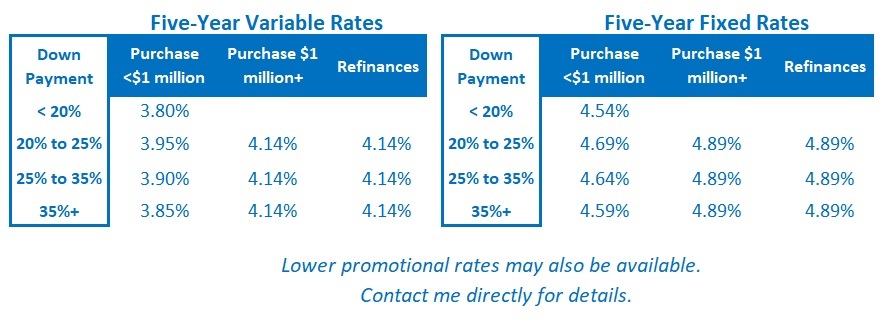
Our fixed mortgage rates held steady last week, but if the downdraft in GoC bond yields continues, fixed-rate reductions should not be far off.
The discounts offered on variable-rate mortgages were also unchanged last week.
Bond-market investors pared back the odds of another 0.25% hike by the BoC in January from approximately 95% to 75% after the Stats Can release of our latest employment data. They are now pricing in approximately three more 0.25% BoC hikes by the end of 2027 (as opposed to the four hikes expected in late October).
My Take on Today’s Mortgage Options
My assessment is unchanged from last week.
Many of the borrowers I am currently working with are choosing fixed rates, and I can well appreciate the appeal of fixed-rate stability in our current volatile environment. I see the value of certainty in an increasingly uncertain world, even if it ultimately comes at higher cost.
When asked for my take on whether a fixed or variable rate is more likely to prove cheaper, I maintain my view that today’s variable rates have the best chance to save borrowers money over their full terms.
Variable-rate mortgage rates increased last week and will likely do so again in the months ahead. But they will have to increase by a full 1.00% from here to reach the levels that are equivalent to most of today’s available fixed rates. I think that is unlikely.
Furthermore, if the current energy supply shock eases and inflation pressures along with it, the BoC will have room to reduce its policy rate if needed.
Variable-rate borrowers will benefit right away if/when that happens, but fixed-rate borrowers will have to wait for their renewal dates (and hope the interest-rate winds are at their backs when that time comes).
In these uncertain times, I think both the odds and enhanced optionality still favour variable rates.
Important notes on potential risks when choosing between fixed and variable rates:
- Anyone choosing a variable rate should do so only if they are comfortable with its inherent potential for volatility. Borrowers must have the financial capacity to withstand higher costs and, in some cases, higher payments.
- As outlined above, fixed rates also come with risk. For example, if bond yields rise sharply in anticipation of higher inflation that doesn’t ultimately materialize, anyone who locked in a fixed rate during the run-up will be paying that associated premium for the balance of their mortgage term regardless of any subsequent rate reductions.
Insider’s Tip for Borrowers
Your income is the single most important factor on your mortgage application because it confirms your capacity to pay, which is the most reliable indicator of a loan’s overall risk.
This post details the two key income tests that are used by lenders, outlines the basic income documentation that will typically be required, and offers advice on how to put your best foot forward.
Three Posts Every New Visitor to My Blog Should Read:
1. Should Canadians Choose a Fixed or Variable Mortgage Rate During a Trade War?
This post provides a detailed comparison of the pros and cons of fixed- and variable-rate mortgages amidst trade-related economic uncertainty.
2. What Every Canadian Borrower Needs to Know About Fixed-Rate Mortgage Penalties
For myriad reasons, often unanticipated, many Canadians end up having to break their fixed-rate mortgages. This post provides a detailed explanation of the very different ways that lenders calculate their fixed-rate mortgage penalties. The amounts charged can vary significantly from lender to lender.
3. What’s in the Fine PrintThis post provides a detailed summary of the key terms and conditions to pay attention to in your mortgage contract. (These are not standard and can vary in important ways.)
Published: November 09, 2026