

Last week Statistics Canada confirmed that our Consumer Price Index (CPI) increased by 3.1% in September (annualized), up from 3.0% in August but below the consensus forecast of 3.2%.
Energy prices once again led the way. Gasoline prices increased by 27.8% year-over-year (y/y).
The Bank’s most closely watched measures of core inflation (CPI-trim and CPI-median) both decreased to 1.8% y/y and 1.9% y/y respectively, and the number of items in the CPI basket that are increasing by more than 3% y/y decreased as well.
Our inflation data still aren’t showing much evidence that higher energy costs are fueling more generalized inflation. But that didn’t stop Bank of Canada (BoC) Governor Macklem from offering a surprisingly hawkish assessment of our current inflation backdrop during a recent media roundtable at the IMP and World Bank Annual meetings in Bangkok.
He warned that the Bank’s latest Monetary Policy Report, which will be released this Wednesday alongside its next policy-rate decision, will contain a substantial upward revision to the Bank’s inflation outlook. He also reiterated his previous warning that higher interest rates may be needed to bring inflation back to its 2% target.
Bond-market investors responded by increasing the odds of a BoC rate hike this Wednesday from 35% to about 80%.
The sudden shift by the BoC surprised many market watchers, including this blogger.
It may have been spooked by its latest Survey of Consumer Expectations, which showed consumer expectations of inflation five years hence increased from 3.4% to 3.9%. That jump raises the concern that longer-term inflation expectations are becoming unanchored, which can lead to inflationary and self-reinforcing changes in consumer spending.
But it must also be noted that the Bank only started surveying consumers’ longer-term inflation expectations in 2015 and that, thus far, there is no compelling evidence that this measure is a reliable predictor of actual consumer behaviour.
To cite an example for comparison, the BoC’s own recent research determined that short-term inflation expectations are substantially backward looking and have not proven to be a particularly reliable leading indicator.
The Bank will also have noted that the three-month annualized average of CPI-trim and CPI-median increased to 2.6% in September from 2.3% in August (as per this recent RBC report). That trend portends increased inflation pressures ahead, but a host of factors may still prevent them from materializing.
As I noted in this recent post, Canadian businesses on average currently have extra-wide profit margins to absorb higher costs (which many intend to do), and there is little evidence that the recent increases in their input prices are being passed through to higher wages (which makes a sustained inflation rise much less likely).
If the BoC does hike, it will do so into a flat economy, a weak employment market with decelerating wage growth, and alongside an accelerating decline in average home prices – all to offset energy prices that are spiking for reasons entirely beyond its control.
Under these circumstances, a rate hike will serve as a blunt and imprecise instrument for the delicate task at hand.
To summarize, I don’t think the BoC should tighten at this point – especially with US President Trump’s next round of threatened tariffs set to kick in on January 1, 2027. But Governor Macklem opened the door to a rate hike in his most recent communications, and the bond market expects the BoC to walk through it this Wednesday.
The Latest on Mortgage Rates
Government of Canada (GoC) bond yields once again finished last week where they started it, with the uneasy tension between upside and downside risks continuing to roughly offset each other.
Fixed mortgage rates held steady and remained range bound at levels about 0.50% higher than they were a few weeks ago.
Variable-rate mortgage discounts were also unchanged last week.
Bond-market investors expect the BoC to hike this Wednesday, and based on Governor Macklem’s recent commentary, now so do I.
My Take on Today’s Mortgage Options
Many of the borrowers I work with today are choosing fixed rates, and I can well appreciate the appeal of fixed-rate stability in our current volatile environment. I see the value of certainty in an increasingly uncertain world, even if it ultimately comes at a higher cost.
When asked for my view on whether a fixed or variable rate is more likely to prove cheaper, I maintain my view that today’s variable rates have the best chance to save borrowers money over their full terms.
If the BoC hikes this week, as expected, variable mortgage rates will increase by the same amount in short order, although that will still leave them well below today’s available fixed rates.
Variable-rate borrowers who are tempted to convert to a fixed-rate should note that doing so will immediately crystalize three more 0.25% hikes into their rate (because the bond yields that our fixed mortgage rates are based on have already priced them in).
Time will tell whether that ends up being the right call (and I should humbly note that it would have been during the post-COVID inflation run-up).
To summarize my current view, I continue to believe that the economic headwinds caused by trade realignment will outlast the inflationary pressures tied to spiking energy prices.
If this view proves correct, the aggressive series of BoC rate hikes currently priced into our fixed mortgage rates are unlikely to occur – and borrowers sticking it out with a variable rate will incur a lower total borrowing cost.
Important note on potential risks when choosing between fixed and variable rates:
- Anyone choosing a variable rate should do so only if they are comfortable with its inherent potential for volatility. Borrowers must have the financial capacity to withstand higher costs and, in some cases, higher payments.
- As outlined above, fixed rates also come with risk. For example, if bond yields rise sharply in anticipation of higher inflation that doesn’t ultimately materialize, anyone who locked in a fixed rate during the run-up will be paying that associated premium regardless of any subsequent yield/rate reductions.
Insider’s Tip for Borrowers
Borrowers often ask me about the impact that a credit check will have on their scores.
This post demystifies how credit scores are calculated and highlights the factors that matter most.
(Spoiler alert: while a periodic credit check does technically drop your score, the impact is both minor and temporary.)
Three Posts Every New Visitor to My Blog Should Read:
1. Should Canadians Choose a Fixed or Variable Mortgage Rate During a Trade War?This post provides a detailed comparison of the pros and cons of fixed- and variable-rate mortgages amidst trade-related economic uncertainty.
2. What Every Canadian Borrower Needs to Know About Fixed-Rate Mortgage Penalties
For myriad reasons, often unanticipated, many Canadians end up having to break their fixed-rate mortgages. This post provides a detailed explanation of the very different ways that lenders calculate their fixed-rate mortgage penalties. The amounts charged can vary significantly from lender to lender.
3. What’s in the Fine Print
This post provides a detailed summary of the key terms and conditions to pay attention to in your mortgage contract. (These are not standard and can vary in important ways.)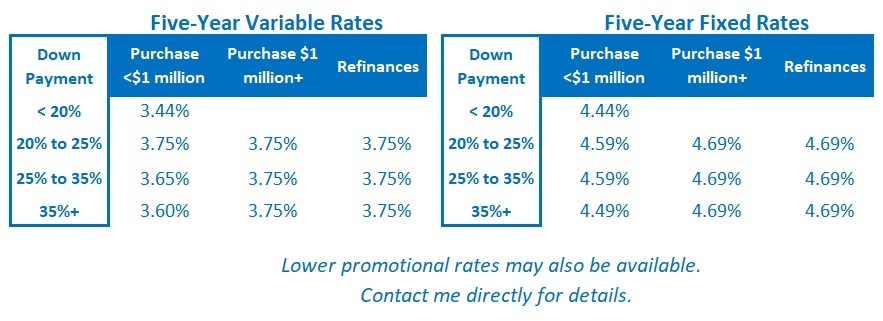
Published: October 26, 2026