


Globe and Mail columnist Andrew Coyne published a thread this week arguing that Canada's population boom had little to do with the run-up in home prices. His case runs like this: population growth only spiked after 2021, home prices took off twenty years earlier, a scatter plot of the two shows no correlation, and Canada grew faster than 2% a year through the 1950s and 1960s without a price explosion. His conclusion is the one we hear constantly from the housing supply crowd: the problem is not too many people, but too few houses.
I agree that we need to build more homes. But the numbers behind this argument don't add up, and the argument itself contradicts the "basic economics" its proponents love to invoke. Let's take it one piece at a time.
When did population growth actually accelerate?
Coyne's chart plots annual population growth going back to 1980 and reads it as flat until a spike in 2022. That is not what the data shows. Statistics Canada publishes population estimates every quarter, and when you look at year-over-year growth by quarter the picture is clearer. Canada grew by about 1% a year from 1990 through 2015. In 2016 the rate stepped up, and by 2018 and 2019 the country was growing at 1.4% to 1.5% a year, the fastest pace since 1990. The 2022 to 2024 surge, when growth hit 3%, came on top of that earlier shift, not out of nowhere.
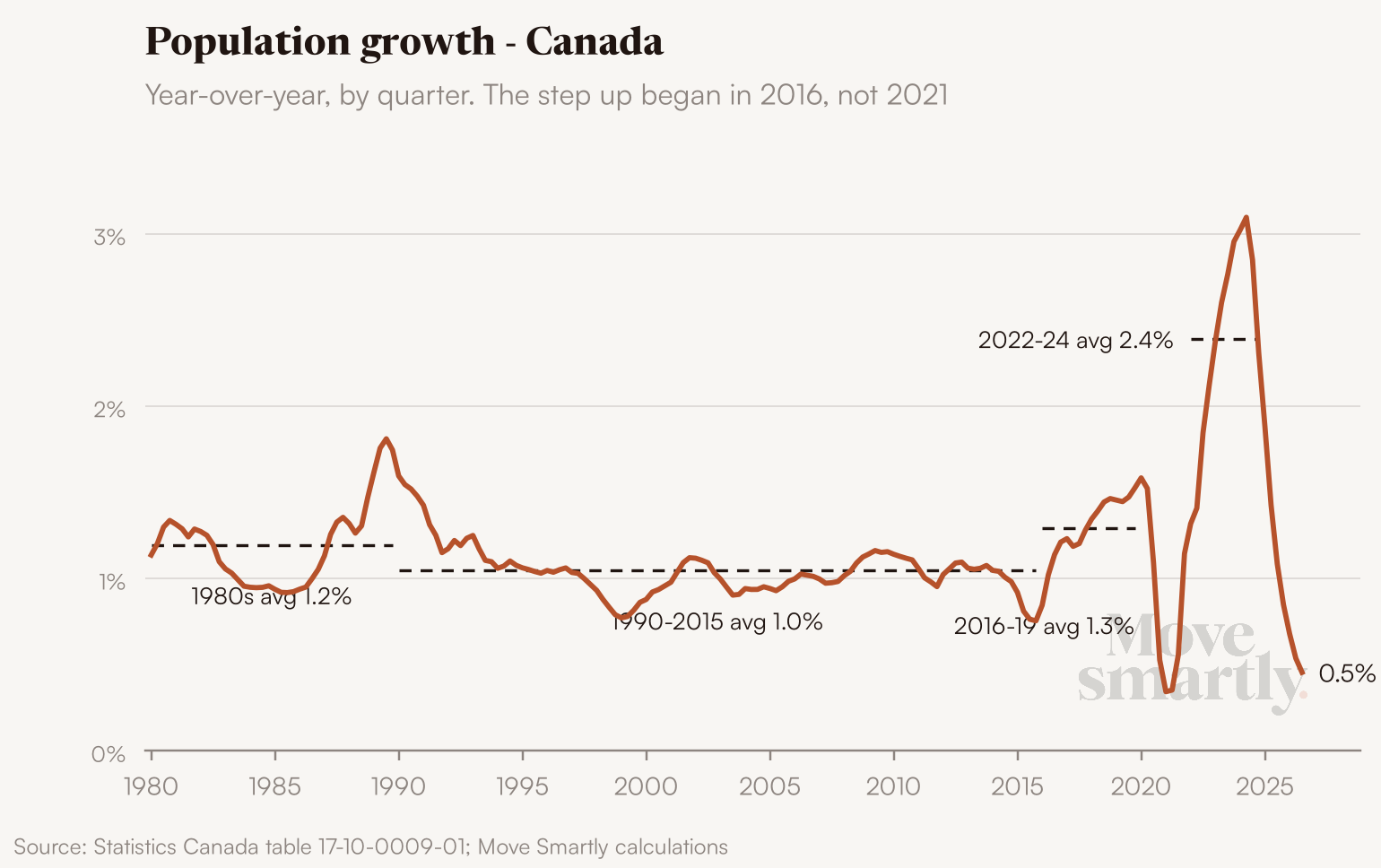
Year-over-year population growth by quarter, with the average for each period. Source: Statistics Canada table 17-10-0009-01.
The change is bigger when you count people rather than percentages. At the end of 2015 Canada was adding 324,000 people a year. Four years later, at the end of 2019, it was adding 583,000 a year, an 80% increase. Almost all of it came from non-permanent residents - temporary workers, international students and asylum claimants. Net growth in non-permanent residents went from roughly zero in 2015 to 190,000 a year by 2019, and net permanent immigration rose from 215,000 to 305,000 over the same four years.
It's worth remembering what was happening in Toronto's housing market at exactly that time. The average price of a home in the GTA rose 17% in 2016 and by over 30% during the first quarter of 2017, the bubble that ended with the Fair Housing Plan and a correction in the second half of 2017. The step-up in population growth and the sharpest two-year price acceleration in the region's modern history happened together. That doesn't prove one caused the other on its own, but it is a strange coincidence to leave out of a thread about why population doesn't matter.
Is there really no correlation?
Coyne's evidence that population growth and home prices are unrelated is a scatter plot of annual Canadian data: each dot is one year, population growth on one axis and real price growth on the other. The dots form a cloud, so he concludes there is no relationship.
The trouble is that a year-by-year scatter for a single country is dominated by the interest rate cycle. The three years of fastest population growth on record, 2022 through 2024, were also the three years of the steepest interest rate increases since 1981. Prices fell during those years because mortgage rates went from under 2% to over 5%, not because adding a million people a year somehow reduced demand for housing. The same thing happened in 1989 and 1990, when strong population growth coincided with the last rate-driven crash. Put those years on a scatter plot and of course the correlation disappears.
A better test compares countries over a longer window, so that the interest rate cycle washes out. BMO Economics did exactly that, looking at average population growth and average home price growth across 18 advanced economies from 2010 to 2020. The relationship is about as clear as anything gets in economics. The correlation is 0.80, and every additional point of annual population growth was associated with roughly four more points of annual price growth. Japan, Italy and Spain, with stagnant or shrinking populations, saw flat or falling prices. Canada, Australia and New Zealand, the three fastest-growing countries in the group, had the fastest price growth.
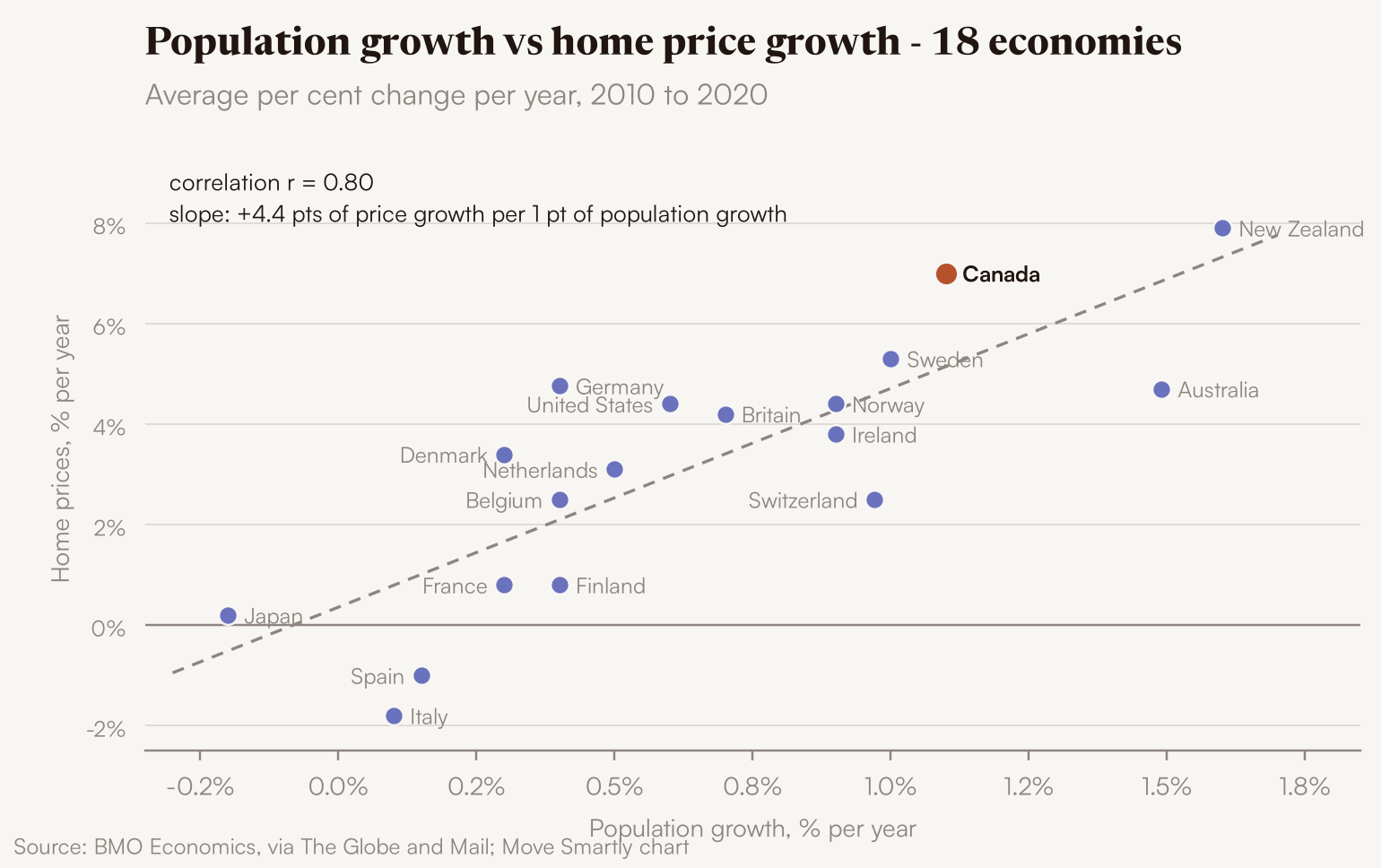
Average annual change, 2010 to 2020. Source: BMO Economics, via The Globe and Mail.
This is where the supply argument runs into a contradiction of its own making. We are told constantly that housing is "just basic economics", supply and demand. But the people saying it are now arguing that an 80% increase in the number of new residents arriving each year by 2019, and a nearly fourfold increase by 2024, had no effect on prices. You cannot have it both ways. If supply and demand set prices, then a surge in demand pushes prices up unless supply responds just as fast, and in a country where it takes years to get a building approved, let alone built, supply does not respond that fast. Population growth is demand.
None of this lets supply off the hook. We need more homes, and more of the right kind of homes. But a policy debate that treats demand as irrelevant is going to keep producing the wrong answers.
About those postwar decades
The last piece of Coyne's argument is that Canada grew by more than 2% a year through the 1950s and 1960s without a housing price explosion, so rapid population growth can't be the problem today. The growth rate part is true. Canada grew 2.7% a year on average in the 1950s and 1.9% in the 1960s.
But where that growth came from matters. In the decade after the war, roughly 70% of Canada's population growth was natural increase - the baby boom - and only about a third came from immigration. Over the past ten years, natural increase accounted for 10% of growth. The other 90%, nearly six million people, arrived from abroad as permanent or non-permanent residents.
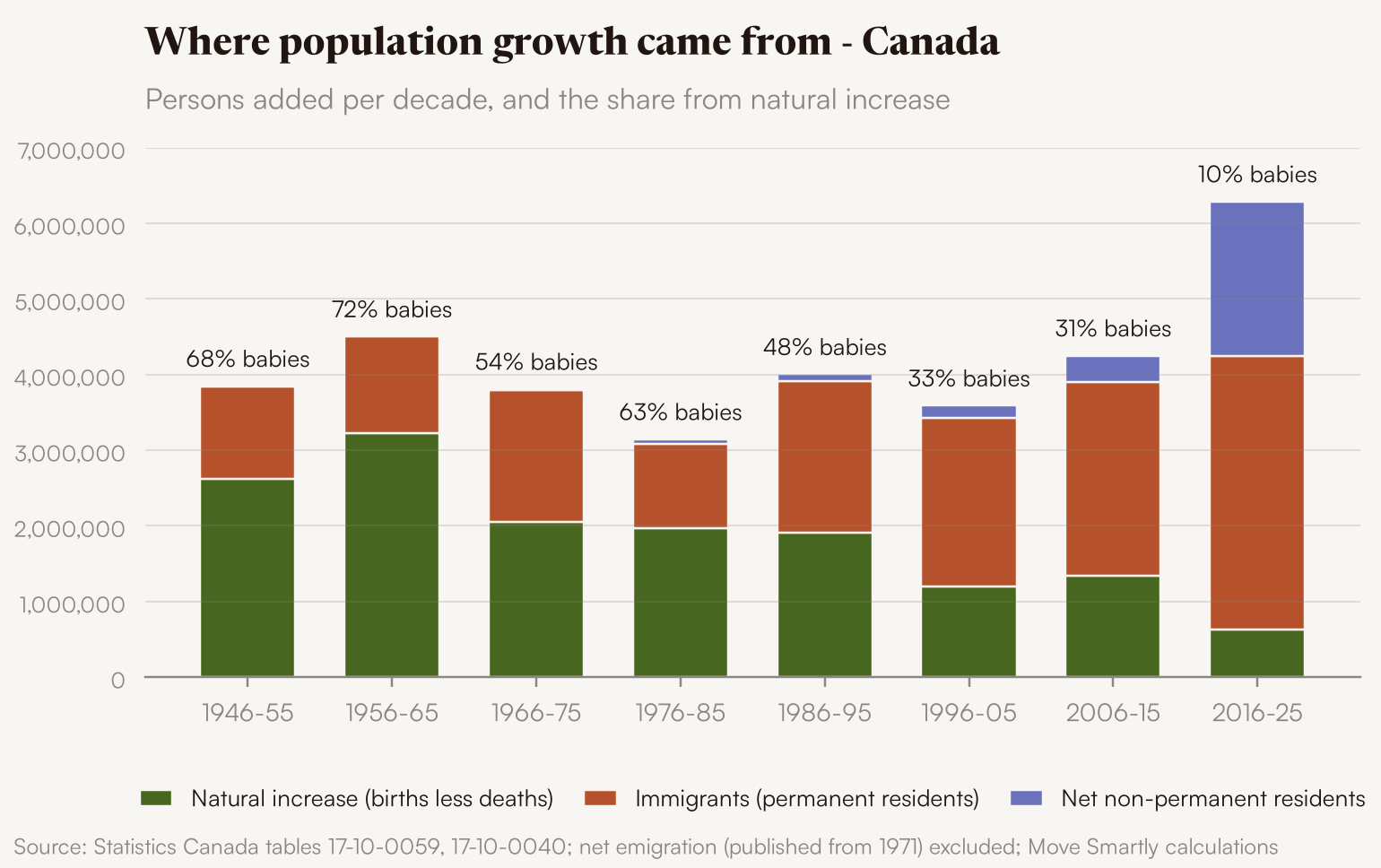
Persons added per decade from natural increase, immigration and net non-permanent residents. Source: Statistics Canada tables 17-10-0059-01 and 17-10-0040-01.
The difference for housing is obvious once you say it out loud. When two babies are born, they move into a bedroom in their parents' home and don't need a place of their own for twenty years. When two new residents arrive from another country, they need a home the week they land. The 2% growth of the 1950s added people to existing households. The 1.5% growth of the past decade added new households, immediately, in a handful of cities that were already short of homes. Measured by the demand for housing, the past ten years were far more intense than anything in the postwar era.
And the supply side of the postwar era was nothing like today's either. It's not just that the suburbs were cheap farmland. Much of the City of Toronto itself was still undeveloped in the 1950s, and the growth of those decades was absorbed by building new low-rise houses on open land across the city and the regions around it. Today nearly all of that land is built out. We are trying to add housing by squeezing tall, dense buildings onto small vacant lots inside an existing city, through fifty years of accumulated zoning and approval rules. That is a far slower and more expensive way to build, which is exactly why supply cannot keep up when demand jumps the way it did after 2015.
Repeating the same mistake
What bothers me most about this argument is not that it gets the dates wrong. It is that it repeats the same narrative that helped get us into this crisis in the first place: the belief that if we just legalize more housing and cut the red tape, supply can respond to any demand shock, however large and however sudden. That is the assumption behind every policy that treated the number of people arriving as something housing would simply absorb. It is obviously not true. Approvals take years, construction takes years more, and the people who build homes respond to prices and financing costs, not to population targets. When demand jumped after 2015, and then tripled after 2021, there was never any chance that supply would keep up, no matter how much zoning we loosened.
None of this is an argument against building more. It is an argument against pretending that demand doesn't exist. Canada ran the experiment of growing the population faster than at any time since the 1950s while telling itself that only the supply side mattered, and the result was the biggest run-up in home prices and rents in the country's history. If we keep repeating the story that population growth had nothing to do with it, we will make the same mistake again.